Wednesday, June 10, 2026

Compensation Caps for 2026


The Office of Federal Procurement Policy (OFPP) recently published the compensation cap for 2026. The new cap is $695,000 and represents a 3.58 percent increase over the 2025 compensation cap of $ 671,000.  

These compensation caps apply to costs incurred during the calendar year, not the Government fiscal year. 

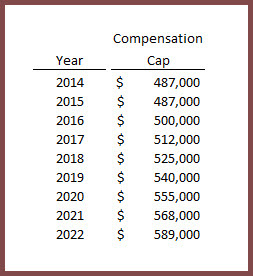
Following are the compensation caps by year:


Prior to 2014, compensation caps were applied variously to 'top five employees in management positions', and 'all employees' depending on the year and whether the contract was awarded by DoD/NASA or a civilian agency. Also, compensation caps prior to 2014 were much higher, peaking at $1.1 million in 2014. If you still have contracts awarded prior to June 24, 2014, you should become very familiar with FAR 31.205-6(p) to ensure accurate implementation of compensation caps.


Wednesday, April 23, 2025

Compensation Caps for 2025

 The Office of Federal Procurement Policy (OFPP) recently published the compensation cap for 2024. The new cap is $ 671,000 and represents a 3.87 percent increase over the 2025 compensation cap of $ 646,000.  

These compensation caps apply to costs incurred during the calendar year, not the Government fiscal year. 

Following are the compensation caps by year:


Prior to 2014, compensation caps were applied variously to 'top five employees in management positions', and 'all employees' depending on the year and whether the contract was awarded by DoD/NASA or a civilian agency. Also, compensation caps prior to 2014 were much higher, peaking at $1.1 million in 2014. If you still have contracts awarded prior to June 24, 2014, you should become very familiar with FAR 31.205-6(p) to ensure accurate implementation of compensation caps.


Monday, October 28, 2024

Interorganizational Transfers

 https://www.jdsupra.com/legalnews/contractors-billing-the-government-for-5682876/


Tuesday, June 11, 2024

Small Businesses Need Accounting Software Designed for the Federal Marketplace

 A transcribed interview by the founder of PROCAS discusses some of the 'compliance' issues that small businesses face when pursuing or thinking of pursuing Government contracts. 

This interview focuses on Accounting and Timekeeping systems and other requirements of the SF 1408 (Accounting Systems). 

You can access the interview here.

This is not an endorsement for PROCAS. We have no first-hand experience with this particular software although it seems to have a lot of features necessary for Government contract accounting.

Thursday, January 4, 2024

Compensation Caps for 2024

The Office of Federal Procurement Policy (OFPP) recently published the compensation cap for 2024. The new cap is $ 646,000 and represents a 4.4 percent increase over the 2023 compensation cap of $ 619,000.  

Following are the compensation caps by year:


Prior to 2014, compensation caps were applied variously to 'top five employees in management positions', and 'all employees' depending on the year and whether the contract was awarded by DoD/NASA or a civilian agency. Also, compensation caps prior to 2014 were much higher, peaking at $1.1 million in 2014. If you still have contracts awarded prior to June 24, 2014, you should become very familiar with FAR 31.205-6(p) to ensure accurate implementation of compensation caps.


IRS Mileage Rate for 2024

 For 2024, the standard mileage rate for business will increase from 65.5 to 67 cents per mile.

The rate for medical and moving will decrease by one cent to 21 cents per mile while the rate for charitable purposes is set by statute and remains unchanged at 14 cents per mile.


Friday, April 28, 2023

Compensation Caps for 2023

The Office of Federal Procurement Policy (OFPP) recently published the compensation cap for 2023. The new cap is $619,000 and represents a 5.1 percent increase over the 2022 compensation cap. This is the largest annual increase since these caps were established by the Bipartisan Budget Act of 2013). 

Following are the compensation caps by year:


Prior to 2014, compensation caps were applied variously to 'top five employees in management positions', and 'all employees' depending on the year and whether the contract was awarded by DoD/NASA or a civilian agency. Also, compensation caps prior to 2014 were much higher, peaking at $1.1 million in 2014. If you still have contracts awarded prior to June 24, 2014, you should become very familiar with FAR 31.205-6(p) to ensure accurate implementation of compensation caps.


Thursday, January 5, 2023

IRS Mileage Rate for 2023


For 2023, the standard mileage rate for business will increase to 65.5 cents per mile

The rate for medical and moving will also increase to 22 cents per mile while the rate for charitable purposes remain at 14 cents per mile.


Wednesday, August 24, 2022

Acquisition Regulation Comparator (ARC)

The new Acquisition Regulation Comparator (ARC) is now live on Acquisition.gov. 

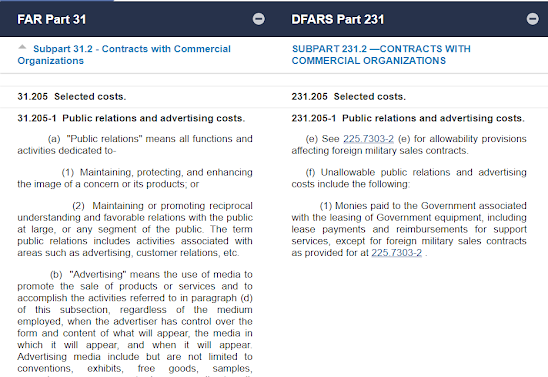
ARC provides users the ability to compare up to three regulations side by side. The results are displayed in a column layout, with regulations compared at the part/subpart level and lined up by the sections.

Its not quite finished however. Currently it contains the FAR, GSAR (GSA FAR Supplement), and DFARS (DoD FAR Supplement) but soon (they say) ARC will release all of the civilian agency acquisition regulations (e.g. NASA, DOE, etc).

ARC is easy to use - select the three regulations you want to compare, select the subpart, and then generate the comparison.

For example, if you have a DoD contract and want to research the cost principle on public relations and advertising (FAR 31.205-1), you need to understand not only the FAR coverage but also whether the DoD FAR supplement adds any additional restrictions on allowability. It does as you can see by this example:


This tool will save time when researching acquisition regulations and whatever FAR supplement is applicable. We hope the civilian agency supplements will be added sooner rather than later.


Tuesday, June 14, 2022

IRS Mileage Rate for the Second Half of 2022

 The IRS just announced an increase in the standard mileage rate for the final six months of 2022.

Effective beginning July 1st, the rate for business travel will increase to 62.5 cents per mile from 58.5 cents per mile.

The rate for medical and moving will also increase four cents per mile from 18 cents to 22 cents.

The IRS stated that the adjustments are necessary to better reflect recent increases in fuel prices.


Wednesday, May 18, 2022

How Do I Find My Cognizant DCAA Office?

This is a repost from a few years back but it also contains an updated link.

If you ever need to find the location of your nearest (or cognizant) Defense Contract Audit Agency office, click here and enter your CAGE Code, your DUNS number or your ZIP code.


Tuesday, December 21, 2021

IRS Mileage Rate for 2022

For 2022, the standard mileage rate for business will increase to 58.5 cents per mile from 56 cents per mile in 2021.

The rate for medical and moving will also increase from 16 to 18 cents per mile while the rate for charitable purposes remain at 14 cents per mile.


Thursday, December 16, 2021

Compensation Caps - 2014 - 2022

Yesterday, we published the recently announced contractor compensation cap for calendar year 2022. Here is a listing of the caps since the cost principles were amended to apply to all employees on contracts awarded after June 24, 2014. 

Prior to that date, compensation caps applied variously to 'top five employees in management positions', and 'all employees', depending on the year and whether the contract was awarded by DoD/NASA or a civilian agency. Also, compensation caps back then were much higher, peaking at $1.1 million in 2014. If you still have contracts awarded prior to June 24, 2014, you should become very familiar with FAR 31.205-6(p).


Wednesday, December 15, 2021

Contractor Compensation Cap for 2022

The Office of Federal Procurement Policy (OFPP) recently published the contractor compensation cap amount for 2022. The cap, for costs incurred between January 1 and December 31, 2022 is $589,000 and applies to all employees on contracts awarded after June 24, 2014.

As a reminder, 'compensation' in this context includes wages, salary, bonuses, deferred compensation, and employer contributions to defined contribution pension plans (see FAR 31.205-6(p)(1)(i)).

Monday, December 30, 2019

Costs Incurred During a Strike Period

FAR (Federal Acquisition Regulations) does not provide specific guidance with respect to the allowability of costs during strike periods.

FAR 22.101-1(b) requires that Governmental Agencies (e.g. DCMA and DCAA) remain impartial concerning any dispute between labor and contractor management and not undertake the conciliation, mediation, or arbitration of a labor dispute. Later provisions in the same FAR section, contracting officers are instructed, in the event that labor disputes give rise to work stoppage, to impress upon contractors that they shall be held accountable for reasonably avoidable delays. Further, all costs incurred during strikes will be carefully examined to ensure recognition of only those costs necessary for performing the contract in accordance with the Government's "essential interest".

Despite its stated neutrality in resolving labor disputes, the Government will be anything but neutral when in comes to paying for strike related costs. Costs directly attributable to the strike, which would not have been incurred otherwise, such as extra security guards, special legal expense, arbitration costs, etc. will all come under close scrutiny and may not be fully reimbursable (even as an indirect expense). Costs which are abnormally higher during the strike period, such as recruitment, training of new employees, etc is another category that will get a lot of attention by contract auditors. Remember, contractors have an affirmative duty to mitigate all strike-related costs.

Costs of a continuing nature will be evaluated based on a number of factors including reasonableness, the extent to which subsequent production makeup operations were undertaken to maintain production schedule, the actions taken to minimize costs during the period and any other factors that have a bearing on the expeditious settlement of the labor dispute.

Sometimes the Government will insist that a contractor accumulate strike related costs and allocate them over the period of the resulting collective bargaining agreement. For example, if the collective bargaining agreement is three years, strike related costs would be accumulated and allocated over production for the next three years.

Friday, December 27, 2019

New Professional Practice Guide (PPG) for Performing Incurred Cost Audits

Section 809 of the 2016 NDAA (National Defense Authorization Act) established the Section 809 Panel to research and recommend improvements to the acquisition process. Section 803 of the 2018 NDAA required the Defense Department to adopt commercially accepted standards of risk and materiality in the performance of incurred cost audits. The Section 809 Panel, with the help of DCAA (Defense Contract Audit Agency) and others, drafted a Professional Practice Guide (PPG) to develop a risk assessment framework intended to 'manage' DoD's risk and materiality approaches to incurred cost audits.

DCAA has now uploaded part of the the PPG to its public website. The Agency included only Chapters 1 and 2 plus Appendix A. It did not include Chapter 3 which deals with internal controls. The PPG has been publicly available for many months but has been buried in the Section 809's 600-page volume 3 final report. DCAA intends to adopt the new risk-based sampling framework for sampling incurred cost proposals and to adopt the materiality standards for performing the incurred costs audits found in the PPG. The first materiality criteria involves the selection of contractors to audit. Once the selection has been made, the second materiality criteria involves what cost elements withing the incurred cost proposal should be audited.

The Professional Practice Guide can be found under the Guidance tab at dcaa.mil. Or, go directly there by clicking here.

Thursday, December 26, 2019

Contractor Charged for Selling Chinese-Made Body Armor to Federal Agencies

Arthur Morgan got himself a GSA (General Services Administration) contract to supply ballistic vests, helmets, riot gear, and other items to the military and to law enforcement agencies. All GSA contracts are subject to the Trade Agreements Act which requires that all products listed on GSA contracts must be manufactured domestically or in a designated country. China is one of many countries not on the "designated country" list.

Various agencies placed orders with Mr. Morgan, nine orders in fact totaling $640 thousand. The Navy was one of those agencies that bought helmets from Mr. Morgan. The problem however was that Mr. Morgan was not manufacturing the helmets nor was he purchasing them from domestic suppliers or from suppliers in a designated country. He was purchasing them from China.

In a series of email exchanges with the Navy over meeting agreed upon delivery schedules, Mr. Morgan falsely advised the Navy that he had a factory in southern Virginia, that the helmets for the order were in production there and the the delays were due to a back-order of materials need for helmet production. However, on the same day that the Navy sent Morgan a partial payment of $127 thousand, Morgan made a payment to a Chinese company that manufactures the exact same helmet as Morgan ultimately delivered to the Navy in the amount of $68 thousand. Now that's a nice profit - based on just the partial payment amount, Morgan earned nearly 100 percent profit. We wonder what the profit percentage amounted to after the Navy made the full payment.

The scheme finally unraveled but the Justice Department is not saying how. Mr. Morgan has been criminally charged and is currently under house arrest (perhaps a flight risk?). Criminal charges do not mean he is guilty. A trial or plea agreement will determine his guilt or innocence at a later date.

The Justice Department press release on this matter can be read or downloaded here.

Tuesday, December 24, 2019

Senator Rand Paul Releases Fall 2019 Edition of "The Waste Report"

Late last month, Senator Rand Paul, who is also the chairman of the Federal Spending Oversight and Emergency Management Subcommittee for the Homeland Security and Governmental Affairs Committee, released the Fall 2019 edition of "The Waste Report". This periodic report looks at how the Government spends taxpayer dollars and identifies eight examples of wasteful spending totaling $230 million. Outside of salaries and wages, social security, medicare, and other social program payments, the primary vehicle for the Government's spending is through contracts and grants. The eight examples of wasteful spending in this current report are rooted in Government contracts and grants. Here's a couple of examples.

The Government purchased textbooks for Afghan schoolchildren to develop, implement, and scale up a nationwide early grade reading curriculum and instruction program. An audit by the Office of Inspector General for Afghan Reconstruction found that the textbooks had significant quality deficiencies, such as loose or blank pages, misspellings, and low-quality paper. A few hundred thousand were still sitting in warehouses but the OIG learned that there were no plans to distribute them. Moreover, many schools reported that because of the poor quality, the books were no longer in usable condition. The grantee responsible for printing and distributing the books blamed parents, students, and school officials for the problem of books falling apart.

The NIH (National Institute of Health) has spent $4.6 million studying the connection between drinking alcohol and winding up in the emergency room. The connection between drinking and driving should be common sense but NIH doesn't trust common sense and doled out money to study the connection between drinking alcohol, hurting yourself or somebody else, and winding up in the ER. So what have scientists concluded? That there is a correlation between drinking and getting hurt. Who in the Government thought that spending $4.6 million for this study was an good use of taxpayer dollars?

The Waste Report is only 16 pages and makes some interesting reading. Don't blame the contractors though. They're just providing a service for what the Government wants to buy.


Monday, December 23, 2019

NDAA 2020 - Post-Award Explanations for Unsuccessful Offerors

The President has now signed the 2020 NDAA (National Defense Authorization Act). A 19 page summary of its key provisions prepared by the Senate Armed-Services Committee can be read or downloaded here. We have been discussing some of the procurement related provisions buried in the bill. So far we've discussed a new requirement for sole-source offerors to provide cost or pricing data it the Government determines that it is necessary to ensure fair and reasonable pricing, a requirement for GAO to study the extent to which DoD is awarding contracts when contractors refuse to provide adequate support, and the repeal of the Defense Cost Accounting Standards Board (DCASB).

Today we will continue the series with a new requirement concerning feedback to unsuccessful offerors. The provision reads, in part:
... FAR shall be revised to require that with respect to an offer for a task order or delivery order in an amount greater than the simplified acquisition threshold and less than or equal to $5,500,000 issued under an indefinite deliver-indefinite quantity contract, the contracting officer for such contract shall, upon written request from an unsuccessful offeror, provide a brief explanation as to why such offeror was unsuccessful that includes a summary of the rationale for the award and an evaluation of the significant weak or deficient factors in the offeror's offer.
There are several things to note here. First, the simplified acquisition threshold currently sits at $150 thousand but there is a FAR proposal on the table that will increase that threshold to $250 thousand. Second, the request must be in writing. It will take a little more than a phone call to get the contracting officer to act. Thirdly, only a "brief explanation" from the contracting officer is required. Don't expect a comprehensive report on the weaknesses found in your offer. Finally, don't expect a comparative analysis of your offers with other offers or with the winning offers. Only a summary of weak or deficient factors is required.

This could reduce the number of bid protests because sometimes, information secured through a bid protest is the only way for offerors to fully understand why they were not selected for a particular contract.


Friday, December 20, 2019

Security Services - In-House or Outsourced?

For contractors employing in-house security protection, DCAA (Defense Contract Audit Agency) thinks you might be paying too much for the services provided. In guidance to its auditors, DCAA writes:
There are now a number of commercial companies that provide plant security protection services, including well-trained uniformed guards. These security service companies often provide efficient plant protection services for less than the cost of such services performed by the contractor's own security employees. Accordingly, evaluation of costs of security guards at the contractor's facilities should include a comparison between the cost of the in-house services and the cost of engaging an outside security service firm. When excessive or unreasonable costs are questioned as a result of the above cost comparison, it is the contractor's responsibility to demonstrate the reasonableness and to justify the costs.
In other words, DCAA thinks it would be cheaper to outsource security guard services then to hire and maintain in in-house security force.

Perhaps the Agency is correct but its certainly not a universal phenomenon.  We have seen a case where a contractor replaced in-house security guards with outsourced services at lower costs. However, the in-house guards were part of a collective bargaining agreement (i.e. "unionized") while the outsourced guards were not. That differential alone represented most of the savings. But all things being equal, outsourced services might be more expensive because the company providing the services need to make a profit.

We would also note that cost is not the only consideration in deciding whether to build an in-house security function or outsource it. Sometimes, contractual requirements may dictate security requirements. Also, in many cases, security personnel serve multiple roles within the company (such as fire protection or drivers).

We recommend that contractors employing in-house security personnel be prepared to demonstrate the reasonableness of the method chosen to provide those services. Without such analysis, its too easy to be "second-guessed" by a contract auditor.