Showing posts with label compensation. Show all posts

Thursday, January 4, 2024

Compensation Caps for 2024

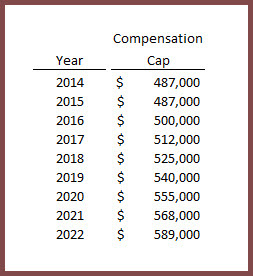
The Office of Federal Procurement Policy (OFPP) recently published the compensation cap for 2024. The new cap is $ 646,000 and represents a 4.4 percent increase over the 2023 compensation cap of $ 619,000.  

Following are the compensation caps by year:


Prior to 2014, compensation caps were applied variously to 'top five employees in management positions', and 'all employees' depending on the year and whether the contract was awarded by DoD/NASA or a civilian agency. Also, compensation caps prior to 2014 were much higher, peaking at $1.1 million in 2014. If you still have contracts awarded prior to June 24, 2014, you should become very familiar with FAR 31.205-6(p) to ensure accurate implementation of compensation caps.


Friday, April 28, 2023

Compensation Caps for 2023

The Office of Federal Procurement Policy (OFPP) recently published the compensation cap for 2023. The new cap is $619,000 and represents a 5.1 percent increase over the 2022 compensation cap. This is the largest annual increase since these caps were established by the Bipartisan Budget Act of 2013). 

Following are the compensation caps by year:


Prior to 2014, compensation caps were applied variously to 'top five employees in management positions', and 'all employees' depending on the year and whether the contract was awarded by DoD/NASA or a civilian agency. Also, compensation caps prior to 2014 were much higher, peaking at $1.1 million in 2014. If you still have contracts awarded prior to June 24, 2014, you should become very familiar with FAR 31.205-6(p) to ensure accurate implementation of compensation caps.


Thursday, February 21, 2019

Compensation for Professional Employees

The Service Contract Act of 1965 was enacted to ensure that Government contractors compensate their blue blue-collar workers and some white-collar service workers fairly. However, the SCA does not cover bona fide executives, administrative, or professional employees.

Professional employees are those having a recognized status based upon acquiring professional knowledge through prolonged study. Examples include accountancy, actuarial computation, architecture, dentistry, engineering, law, medicine, nursing, pharmacy, and the sciences. To be a professional employee, a person must not only be a professional but must be involved essentially in discharging professional duties.

It is the Government's policy that all professional employees be compensated fairly and properly. To this end, contracting officers will sometimes include in solicitations a requirement for offerors to submit for evaluation a total compensation plan setting forth proposed salaries and fringe benefits for professional employees working on the contract. This solicitation clause is found at FAR 52.222-46, Evaluation of Compensation for Professional Employees. This is a required clause when the contract is expected to exceed $700 thousand and the service to be provided will require meaningful numbers of professional employees.

If this clause is included in a solicitation, offerors must submit for evaluation a total compensation plan setting forth proposed salaries and fringe benefits for professional employees who will be working on the contract. Supporting information will include data such as recognized national and regional compensation surveys and studies of professional, public, and private organizations, used in establishing the total compensation structure. Plans indicating unrealistically low professional employee compensation may be assessed adversely as one of the factors considered in making an award.

The Government has a right to be concerned about unrealistically low wages. Re-competition of service contracts may in some cases result in lowering the compensation paid to professional employees and lower wages can be detrimental to obtaining the quality of professional services needed for adequate contract performance. Therefore it is in the Government's best interest that professional employees be properly and fairly compensated.

So what does the Government look for when evaluating compensation plans? The Government will evaluate plans to assure that they reflect a sound management approach and understanding of contract requirements including an assessment of offerors' ability to provide uninterrupted high-quality work. It will be evaluated in terms of its impact on recruiting and retention, its realism, and its consistency. Other factors that the Government might consider when evaluating a compensation plan include:

  • The capability of the compensation structure to obtain and retain suitably qualified personnel to meet mission objectives.
  • Salary rates or ranges that take into account differences in skills, complexity of various disciplines, and professional job difficulty.
  • Where proposed compensation levels are lower than those of predecessor contractors, evaluating on the basis of maintaining program continuity, uninterrupted high-quality work and availability of replacements.

Unrealistic compensation plans will probably be viewed as evidence of failure to comprehend the complexity of contract requirements and failure to submit a plan at all, will cause the rejection of a proposal.

The Government estimates that about 10,000 (or so) compensation plans are submitted for evaluation each year.


Wednesday, January 9, 2019

"War Hazard" Premium Payments

Contractors operating in unusually dangerous situations find they must offer hazardous duty payments to attract employees willing to work under those conditions. Probably everyone at some point has been regaled with accounts by a relative, friend, neighbor, or acquaintance about the bucket loads of money they accumulated by taking a contract gig in Iraq or Kuwait, or Afghanistan. Unfortunately, more than 1,600 of those contractor employees did not make it back alive and that's why war hazard pay becomes necessary.

Incentives vary among contractors and usually reflect differences in individual circumstances and reasonableness must be established on a case by case basis. Sometimes contract solicitations will provide guidance. Among contractors operating in hostile areas, there are standards and unwritten rules. The State Department may also be a source of premium amounts applicable to specific locations.

Contractors proposing (and paying) premium pay will, at some point, be asked to justify the reasonableness of the premium pay amounts. This could get a little tricky because it involves a high level of judgment in evaluating factors such as:

  1. Country and city where assigned
  2. Distance of work site from actual battle lines and surrounding areas of imminent danger
  3. War hazard differentials being offered by other defense contractors in the same location
  4. Employee response to any lower war hazard differential pay offers made by the contractor
  5. Availability of alternate workers at appropriate skill level, and
  6. Other compensation offered, such as bonuses and insurance coverage.

Because these premiums can be subjective and to avoid disputes down the road, we recommend that any contractor (or subcontractor) pursuing work where war hazard pay is necessary to enter into an advance agreement with their cognizant contracting officer over the amount and breadth of such payments.


Tuesday, September 4, 2018

Government Contractor Employees Earning Minimum Wage Will Receive a 2.4% Increase in January

Last week, the President's decision to forgo a cost of living pay raise for Federal Government employees in 2019 made national news. Other than the Federal workforce and related organizations (e.g. AFGE), not too many gave the decision a passing thought. These decisions however have a way of reverberating back to the public who need an efficient Government bureaucracy, including Government contractors who rely on Government employees to solicit, award, and administer their contracts. The impact may not be felt immediately but it impacts the Government's ability to attract and retain (emphasis on retain) a capable workforce. Spend any time at all with Government employees and you'll soon hear them bemoaning the loss of employees who left for better pay, better working conditions, and better appreciation. They too are looking for an exit. Who's going to fill their shoes? Someone with inexperience, likely. We recently encountered a contracting officer making million dollar decisions, with six months of experience under her belt.

Contractors certainly have their share of anxieties over Government foibles but one thing they don't have to worry about is the Government restricting pay raises (as long as the raises are reasonable). In fact, in some cases, the Government mandates certain pay raises. A few years back, the President issued an executive order setting a minimum wage for contractor employees working under Government contracts. The minimum wage adjusts every year based on a prescribed formula. It started at $10.10 per hour and is currently $10.35 per hour. Beginning in January 2019, the minimum wage increases to $10.60 per hour (a 2.4 percent increase).

Now we don't know how many contractor employees are affected by this Executive Order. We suspect that in the aggregate, the number of contractor employees earning minimum wages is significant but as a percentage of the contractor workforce, not significant. Employees on contracts covered by Davis-Bacon or the Services Contracting Act are already earning more than minimum wage. It seems most likely that minimum wage personnel are those paid for with non-appropriated funds, such as concessionaires on military bases. In any event, if you are a contractor with minimum wage employees, you will need to factor this pay raise into future budgets.

Tuesday, August 28, 2018

Rule Prohibiting Retaliation for Disclosure of Compensation Information Becomes Final

The FAR (Federal Acquisition Regulations) have converted an interim rule to a final rule, without change. This new rule, based on an Executive Order (EO) from the previous Administration prohibits Federal Contractors from discriminating against employees and job applicants who inquire about, discuss, or disclose their own compensation or the compensation of other employees or applicants. This rule applies to all contractors, both small (fewer than 500 employees) and large.

The regulation contains definitions of "compensation" and "compensation information" which are rather intuitive as you might expect (those definitions can be found in FAR  52.222-26(a)). The fundamental requirements of the regulation are these:

  1. The contractor shall not discharge or in any other manner discriminate against any employee or applicant for employment because such employee or applicant has inquired about, discussed, or disclosed the compensation of the employee or applicant or another employee or applicant.
  2. This prohibition against discrimination does not apply to instances in which an employee who has access to the compensation information of other employees or applicants as part of such employee's essential job functions discloses the compensation of such other employees or applicants to individuals who do not otherwise have access to such information, unless such disclosure is in response to a formal complaint or charge, in furtherance of an investigation, proceeding, hearing, or action.
  3. The contractor shall disseminate the prohibition on discrimination to employees and applicants by incorporation into existing employee manuals or handbooks and electronic posting or by posting a copy of the provision in conspicuous places available to employees and applicants for employment.

We suppose that this regulation was a nod to some interest group but we have never heard of an instance where an employee or applicant was discriminated against for disclosing compensation information.We were kind of surprised that the current administration let this interim rule become final but perhaps it was the easiest path and its a "do-nothing" regulation. But in the current environment with the Section 809 Panel trying to weed out useless procurement regulations, it would have been a logical one to drop.

Contractors, don't forget to disseminate this new prohibition.

Thursday, December 28, 2017

Weather Related Closures - Repost

With inclement weather conditions in many parts of the country, here's a link to a previous posting on how the Government will view costs related to facility closures.

Weather Related Closures

Monday, May 15, 2017

Paid Administrative Leave - Allowable, or Not?

The Government pays employees for administrative leave for a lot of reasons; specific Government-wide examples include emergency dismissals, civilians returning from active military duty, voting, or the death of a president. Beyond that, agencies can use administrative leave when such leave is directly related to the agency's mission to enhance the development or skills of the employee, or be as brief as possible and in the interest of the agency. Some past examples have included the Employee Assistance Program, blood donations or agency-approved volunteering (though one wonders if the employee is being paid, is that truly volunteering). Some employees have been placed on administrative leave pending the outcome of an investigation or pending a physical examination. According to OPM (Office of Personnel Management), the Government's HR (Human Resources) Department, administrative leave should never be used for an extended or indefinite period of time or used on a recurring basis.

So what about Government contractors and their use of paid administrative leave? What does FAR (Federal Acquisition Regulations) say about paid administrative leave?

The second of these two questions is easy. FAR is silent on the matter. There is nothing in FAR 31.205-6 (Compensation) or any other cost principle that addresses the subject of paid administrative leave. Paid administrative leave would probably fall under the general category of fringe benefits so that would make such costs allowable as long as they are reasonable.

Contractors should expect to provide some rationale and circumstance for uses of paid administrative leave. If there is a valid reason and it is what a "prudent person in the conduct of competitive business" would normally expect to occur, there there should be no reason for the Government to come along and try to disallow the costs.

If however, the use of paid administrative leave was for some disciplinary action associated with improper conduct by an employee, the allowability would probably be contingent upon the outcome. The costs might initially be charged to the Government pending an investigation, adjudication and final decision. The costs might then become unallowable if the contractor were "at fault" once the situation is fully resolved.

We recommend that contractors develop written policies for the use of paid administrative leave with descriptions for how such payments will be accounted for under different scenarios. Also, if the costs become significant, consider an advance agreement with your administrative contracting office to avoid future conflicts.

Friday, December 9, 2016

Update on the 2014 Compensation Cap Law


Section 702 of the Bipartisan budget Act of 2013 (BBA) established a cap of $487,000 per year on the amount the Federal Government will reimburse contractors employee compensation on contracts with defense and civilian agencies. By law, this amount must be adjusted annually to reflect the change in the Employment Cost Index for all workers, as calculated by the Department of Labor, Bureau of Labor Statistics (BLS). This cap applies to all contracts awarded after June 24, 2014 but so far, OMB (Office of Management and Budget) has not increased the cap so contractors should be proposing and seeking reimbursement for no more than the current $487,000 cap. Perhaps the change in the Employment Cost Index has not been sufficient to move the cap.

Section 702 of the BBA also required OMB and DoD to report to Congress on alternative benchmarks and industry standards to the benchmarks established by the BBA. OMB and DoD performed a study and solicited industry comments on several alternatives including:

  • creation of multiple caps
  • use of "say-on-pay" principle (i.e. compensation voted on by stockholders)
  • use of alternative inflators to adjust the cap, and
  • creation of an alternative definition of compensation to address the scope of the cap.

Ultimately, OMB and DoD concluded that none of the four alternatives would be more effective than the benchmark established by Section 702 which, they believed, was a substantial improvement over the statutory formula it replaced.

Finally, Section 702 allows agency heads to establish one or more narrowly targeted exceptions for scientists, engineers, or other specialists upon a determination that such exceptions are needed to ensure that the executive agency has continued access to needed skills and capabilities. It also requires OMB to report annually on use of the exception authority, including the total number of contractor employees, the taxpayer-funded compensation amounts, and the duties and services performed.

For fiscal years 2014 and 2015, OMB reported that no exceptions were granted. Information for fiscal year 2016 is not yet available. No company has been brave enough to request an exemption yet.

It appears that the $487,000 cap, adjusted for changes in the Employment Cost Index, will be the benchmark for the foreseeable future.

Monday, October 3, 2016

New Regulation Preventing Contractors From Retaliating Against Employees Who Disclose their Compensation Level

Last week the FAR (Federal Acquisition Regulation) Councils published a spate of new regulations. We discussed one of those last Friday (see Prohibition on Contracting with Delinquent Taxpayers and Felons) and will continue our coverage this week on several that directly affect Government contractors (and prospective contractors). Today we'll discuss the new prohibition on retaliating against employees who disclose or discuss compensation matters. Now you might think that this is old news and it is, in a way. In 2014, the President issued an executive order (E.O.) called "Non-Retaliation for Disclosure of Compensation Information". That was followed in September 2015 with the Department of Labor's implementing rule entitled "Government Contractors, Prohibitions Against Pay Secrecy Policies and Actions". So, why is it necessary to add more rules; rules upon rules? The FAR Council's rationalize it this way:
Issuance of an interim rule allows for the requirements to be included in solicitations and contract immediately and puts contractors on clear notice of legal responsibilities that are already in effect. If the FAR rule is not issued ... this new requirement will not be incorporated into contracts, and contractors will be put at unnecessary risk of non-compliance with the E.O and labor rule. More importantly, this may unnecessarily delay action by contractors in providing the important protections for contract employees that the E.O. and labor rule are designed to provide.
The new rule prohibits contractors (and subcontractors) from discharging, or in any other manner discriminating against, any employee or applicant for employment because the employee or applicant inquired about, discussed, or disclosed the compensation of the employee or applicant or another employee or applicant.

This prohibition against discrimination does not apply to instances in which an employee who has access to compensation information of other employees or applicants as part of such employee's essential job functions discloses the compensation of such other employees or applicants to individuals who do not otherwise have access to such information, unless such disclosure is in response to a formal complaint or charge, in furtherance of an investigation, proceeding, hearing, or action, including an investigation conducted by the employer, or is consistent with the contractor's legal duty to furnish information.

So now, employees may chatter freely about the compensation levels without fear of reprisal. A quick internet search didn't show any cases of reprisals against employees who disclosed their compensation information but, by golly, we now have a regulation in place - just in case it ever happens.


Wednesday, September 21, 2016

Mandatory Pay Raises for Many Contractor Minimum-Wage Employees

Yesterday, the Wage and Hour Division of the Department of Labor (DOL) issued a notice announcing the applicable minimum wage rate to be paid to contractor employees performing work on or in connection with Government contracts.

That rate which becomes effective on January 1, 2017 will increase by $0.10 per hour from $10.10 to $10.20 per hour.

This minimum wage for Government contractor employees was based on a Presidential executive order from 2014 and became effective on January 1, 2015. The executive order and related regulations call for automatic annual increases based on the change in the Consumer Price Index for Urban Wage Earners and Clerical Workers (CPI-W) rounded to the nearest nickle.

Contractors affected by this minimum wage increase need to factor it into their forward pricing proposals and, to the extent impacted, their forward pricing indirect expense rates and provisional billing rates.

The full text of the new rules can be found here.

Monday, October 19, 2015

Health Care Costs for Ineligible Dependents

The brouhaha over contractors paying for health care costs of ineligible dependents has largely died down since last year. The largest category of ineligible dependents are those who have "aged" out of the company plan. Employees often forget to notify HR when there is a change is status for healthcare eligibility and historically, many contractors did not have procedures in place to validate dependent eligibility. See Health Care Benefits Paid to/for Ineligible Dependents for further information on this subject.

But just because its not in the news any longer, doesn't mean that the subject is being ignored. Contract Auditors continue to test contractor policies and procedures for ensuring the eligibility of dependents. The standard audit program for audits of all incurred costs, no matter the contractor size, included the following:
Health Care Costs. As part of the review of health care costs, verify the contractor included only health insurance premiums and claims for “eligible dependents”. Request the contractor to demonstrate its procedures for ensuring only costs related to eligible dependents have been included in the claimed costs. Based on the understanding of the contractor’s processes and overall risk, design procedures to test claimed costs are related to only eligible dependents. 
The focus of this audit procedure is the contractor and the contractors procedures for ensuring only costs for eligible dependents have been claimed. If contractors do not have such procedures in place or do have but they are deficient in some respect, the auditor could make any number of recommendations. We saw one case where, in 2013, the auditor demanded a contractor prove that a listing of dependents from 2006 were eligible for medical care. The contractor couldn't so the auditor questioned all of the dependent health care costs, whether eligible or not. That disagreement is still pending with the contracting officer.

Tuesday, September 15, 2015

Contractors Cannot Discriminate Against Employees Who Chat About Their Compensation

Yesterday we brought you the first installment on the new regulations that prevent discrimination on the basis that contractor employees decide to chat about the compensation levels. If you missed it, click here to begin your reading.  The idea behind the President's Executive Order (EO) was that if employees know how much each other makes, the pay disparity that exists between men and women performing the same work, will narrow and perhaps reach parity. No one really knows whether such prohibitions will have an impact. By the Government's own admission, it is based on untested theories. Additionally, no one has come forth with even anecdotal evidence that employees have been discriminated against for divulging their compensation level to fellow employees. Regardless, Government contractors have a new set of regulations to deal with.

The salient part of the new regulation reads:
(3) The contractor will not discharge or in any other manner discriminate against any employee or applicant for employment because such employee or applicant has inquired about, discussed, or disclosed the compensation of the employee or applicant or another employee or applicant. This provision shall not apply to instances in which an employee who has access to the compensation information of other employees or applicants as a part of such employee's essential job functions discloses the compensation of such other employees or applicants to individuals who do not otherwise have access to such information, unless such disclosure is in response to a formal complaint or charge, in furtherance of an investigation, proceeding, hearing, or action, including an investigation conducted by the employer, or is consistent with the contractor's legal duty to furnish information.
Contractors must post in conspicuous places, available to employees and applicants for employment, notices to be provided by the contracting officer setting for the provisions of this nondiscrimination clause.

If there is ever an allegation of discrimination, contractors must furnish all information required by the rules, regulations, and orders of the Secretary of Labor and will permit access to its books, records, and accounts by the contracting agency and the Secretary of Labor for purposes of investigation to ascertain compliance with such rules, regulations, and orders.

If a contractor becomes noncompliant with these rules, the contracting officer may cancel, terminate, or suspend the contract and the contractor may be declared  ineligible for further Government contracts. That doesn't seem likely to happen, but it is part of the regulations.

There is more to these new regulations than we can cover here. For more information, click here for the complete rules.


Monday, September 14, 2015

Employees Can Discuss Their Compensation Levels With One Another

Back in April 2014, the President issued an Executive Order entitled "Non-Retaliation for Disclosure of Compensation Information" which prohibits Government contractors from discharging or discriminating in any way against employees or applicants who inquire about, discuss, or disclose their own compensation or the compensation of another employee or applicant. Read our posting back when the EO was issued by clicking here.

Last week, the Office of Federal Contract Compliance Programs (OFCCP) issued final regulations implementing the Executive Order. The prohibition against discriminating because of race, color, religion, sex, sexual orientation, disability, etc has been on the books for awhile. The EO adds a provision that prohibits Government contractors from discriminating against employees who disclose, inquire, or discuss their own compensation or that of others.

The purpose of this EO is to try and close the compensation gap between men and women. According to the Government, a pay gap between men and women persists today. When stratified by racial group, the statistics are the same, men earn more than women. According to a BLS (Bureau of Labor Statistics) survey from 2013, women make 82 percent of what men make. Among the possible contributing factors to the enduring pay gap is the prevalence of workplace prohibitions on discussing compensation.

Whether communicated through a written employment policy or through informal means, restrictions on revealing compensation can conceal compensation disparities that exist among employees. One recent survey found that 51 percent of female respondents and 47 percent of male respondents reported that the discussion of wage and salary information is either discouraged or prohibited and could lead to punishment.

The Government believes that prohibitions on discussing pay prevent employees from knowing whether they are underpaid in comparison to their peers. Underpaid employees will remain unaware of the disparity if compensation remains hidden.

Now how does this affect Government procurement?

First, Government contractors with pay secrecy practices are subject to enforcement actions and, as a result, may face a higher risk of disruption, delay and expense associated with contract performance. Allowing discussions of pay by employees of these contractors will contribute to minimizing these risks.

Second, Government contractors with pay secrecy policies may also experience a decrease in worker productivity. Workers, due to a lack of compensation information, may experience a reduction in performance motivation and are likely to perceive their employer as unfair or untrustworthy. Both reduce work productivity.

The Government even admits that these potential impacts are only theories that have not been investigated but nevertheless, are serving as the basis for the new policy. The OFCCP notes that in addition to these benefits, this final rule is expected to result in increased wage payments to employees and recognizes that it could very well result in increase costs to Government contracts.

 Tomorrow we will discuss the specific requirements that Government contractors must adhere to under these new rules.


Thursday, July 30, 2015

DCAA Compensation Reviews - Materiality Thresholds

This is the fourth and final part in our series of articles that examine the methodologies used by the Government to assess compensation reasonableness in the post JF Taylor/Metron era. There were two ASBCA (Armed Services Board of Contract Appeals) cases from 2012; JF Taylor (ASBCA Nos. 56105, 56322) and Metron (ASBCA Nos. 56624, 56751, 56752) that were (mostly) decided in favor of the appellants (i.e. the contractors). In deciding for the appellants, the ASBCA criticized the methodologies employed by DCAA in deriving its estimates of "reasonableness". You can refer to the following past articles for a recap of those decisions.


In Part 1 of this series, we explained how DCAA continues to utilize the "fatally flawed" methodologies of the past to audit compensation costs. DCAA rationalizes that their methodologies were not repudiated - they just didn't have the right "expert" on the case to rebut the contractor's experts. In Part 2, we noted some cases where the contracting officers, rather than trying to defend the DCAA position on compensation, disregarded the audits and took matters into their own hands by performing their own analysis of compensation reasonableness. In Part 3, we discussed the difficulty in assessing the qualitative factors that enter into compensation levels and how DCAA often gives no consideration to such factors in deriving their "reasonableness" recommendations.

In Part 4, we want to address materiality. Materiality is a factor in setting the scope of any audit. Immaterial costs are less likely to be audited than significant items and may be omitted from audit coverage altogether. It makes business sense and audit sense to use scarce resources where the potential payback is most significant.

DCAA has set a threshold for executive compensation below which their compensation experts don't want to be bothered. DCAA keeps that threshold confidential but in 2011, the threshold was $165,000. DCAA wrote:
We use a materiality threshold that states that if the claimed cash compensation (base salary plus bonus) is less than $165,000 for the top paid executive, we determine the compensation to be reasonable based on a cursory review ... and do not need to perform a detailed review of this information.
Of course, that does not preclude other DCAA components from diving into reasonable determinations or contracting officers from doing the same. But, it seems unlikely that if the DCAA team in charge of compensation reviews is not interested in compensation below that threshold, no one else is going to get excited either.

Notwithstanding formal compensation reviews, auditors will typically scan positions and accompanying compensation levels to look for outliers. For example if a clerk/typist shows up at $160,000 per year, you can be assured that the auditor will ask questions and dig deeper.


Wednesday, July 29, 2015

DCAA Compensation Reviews - Qualitative Factors Affecting Compensation


This is the third part in our series of articles that examine the methodologies used by the Government to assess compensation reasonableness in the post JF Taylor/Metron era. There were two ASBCA (Armed Services Board of Contract Appeals) cases from 2012; JF Taylor (ASBCA Nos. 56105, 56322) and Metron (ASBCA Nos. 56624, 56751, 56752) that were (mostly) decided in favor of the appellants (i.e. the contractors). In deciding for the appellants, the ASBCA criticized the methodologies employed by DCAA in deriving its estimates of "reasonableness". You can refer to the following past articles for a recap of those decisions.


In Part 1 of this series, we explained how DCAA continues to utilize the "fatally flawed" methodologies of the past to audit compensation costs. DCAA rationalizes that their methodologies were not repudiated - they just didn't have the right "expert" on the case to rebut the contractor's experts. In Part 2, we noted some cases where the contracting officers, rather than trying to defend the DCAA position on compensation, disregarded the audits and took matters into their own hands by performing their own analysis of compensation reasonableness.

In this Part 3, we want to point out that there are both quantitative factors and qualitative factors that affect compensation levels (sometimes these are referred to as objective and subjective factors). DCAA's methodologies in assessing compensation relies heavily on quantitative factors (e.g. salary surveys). Qualitative (or subjective) factors that affect compensation levels require someone to exercise judgment as to how those factors affect compensation levels. DCAA is not prone to giving consideration to such factors. In fact, DCAA is more likely to argue against any qualitative factors than try to give recognition to them.

According to DCAA, "... there are two types of information to look at: quantitative and qualitative." The quantitative factors are easy for DCAA to determine - take the 50th percentile from two or more surveys of companies with comparable sales, job descriptions, and industry, average the results, add 10 percent and you have your reasonable compensation benchmark. The qualitative factors on the other hand are difficult to quantify and we don't recall a case where DCAA bumped the quantitative assessment of reasonableness for qualitative factors. That's not saying they haven't because, of course, we are not privy to all of their audits. But we have seen quite a few.

Examples of qualitative factors (the ASBCA calls them "discriminators that may explain variations in compensation) would include security clearances, customer satisfaction, company growth trajectories, performing multiple functions, awards and recognition, to name a few.

In one case, rather than trying to quantify the qualitative factors, DCAA simply advised the contracting officer to use her own judgment as to how those factors entered into the reasonableness equation.

It seems unlikely that DCAA is ever going to address qualitative factors affecting compensation reasonableness. Contractors that expect qualitative considerations should be prepared to address those factors with their contracting officers.


Tuesday, July 28, 2015

DCAA Compensation Reviews - Contracting Officer Involvement


This is a second in our series of articles that examine the methodologies used by the Government to assess compensation reasonableness in the post JF Taylor/Metron era. There were two ASBCA (Armed Services Board of Contract Appeals) cases from 2012; JF Taylor (ASBCA Nos. 56105, 56322) and Metron (ASBCA Nos. 56624, 56751, 56752) that were (mostly) decided in favor of the appellants (i.e. the contractors). In deciding for the appellants, the ASBCA criticized the methodologies employed by DCAA in deriving its estimates of "reasonableness". You can refer to the following past articles for a recap of those decisions.


In Part 1 of this series, we explained how DCAA continues to utilize the "fatally flawed" methodologies of the past to audit compensation costs. DCAA rationalizes that their methodologies were not repudiated - they just didn't have the right "expert" on the case to rebut the contractor's experts.

Today we want to identify what we think may be a growing trend by contracting officers to come to their own conclusions regarding compensation reasonableness. Okay, maybe we don't have a trend - maybe its just a couple of anecdotes - but it could become a trend.

We know of a couple of cases where contracting officers' (DCMA contracting officers, in these cases) totally disregarded the DCAA recommendations (based on the three-survey average plus 10%) and performed their own analysis. In one case, the contracting officer asked the contractor to go out and "buy" a survey representative of its size, industry, location, etc and based on that survey, offered the contractor a compensation level at the 75th percentile. Although still less than claimed, the contractor accepted it. In the decision, the contracting officer specifically refused, in light of the J F Taylor case, to accept DCAA's position. The ACO considered DCAA's position dead on arrival. The other case was similar - the contracting officer used a single survey but was not quite as generous in the percentile offering.

The lesson here for contractors is to recognize that DCAA is very intransigent when it comes to defending its position so its best to go right to the contracting officer to resolve the issues. This is not to say that the contracting officer will give away the shop but they seem to be smart enough not to want to defend a position that doesn't comport with case law.


Monday, July 27, 2015

DCAA Compensation Reviews - Current Methodologies Used

Those of you following compensation issues as they relate to costs charged to Government contracts are no doubt familiar with the two ASBCA (Armed Services Board of Contract Appeals) cases from 2012; JF Taylor (ASBCA Nos. 56105, 56322) and Metron (ASBCA Nos. 56624, 56751, 56752). The ASBCA found for the contractor (mostly) in both decisions while criticizing the methodologies employed by DCAA in deriving its estimates of "reasonableness". Refer to the following postings for a brief summary of those decisions.


Over the next few days, we will be reporting on our own post-JF Taylor/Metron observations and experiences. We have two general observations. DCAA has not substantively changed the way it audits compensation costs, even though the methodologies it continues to use were called into question in these cases.  Secondly, contracting officers seem to be less likely to follow or rely upon DCAA recommendations and in some cases, have become their own compensation "experts".

We will address the first observation today. The question we keep asking ourselves is why does DCAA continue to employ the same methodologies today, that were called "fatally flawed"  in the J.F. Taylor case. That methodology averaged two or three statistical studies (compensation surveys) and added a 10 percent range of reasonableness.

The short answer here is that DCAA does not believe it lost the J.F. Taylor case on its merits. In 2014 correspondence addressing the applicability of the J.F. Taylor case, DCAA wrote:
... as specifically noted in the Board decision, the JF Taylor expert's statistical arguments were accepted by the ASBCA because the evidence was "unrebutted" by the Government. Had we rebutted the evidence, the outcome may have been different. Therefore, we continue to utilize our methodology...
So there you have it. DCAA continues to add a ten percent range of reasonableness to the average (i.e. 50th percentile) of several surveys as benchmarks to assess the reasonableness of compensation.


Monday, December 15, 2014

New Interim FAR Rule on Minimum Wage Requirements

Did you know that raising employee wages will reduce contract costs? According to the Government, in an interim rule issued today (December 15, 2014), that is exactly what will happen on February 13, 2015 when the new minimum wage rules begin applying to FAR-based contracts. Although that logic may seem counter-intuitive, the Government reasons that raising the minimum wages for employees working on Government contracts to $10.10 per hour will increase efficiency and costs savings because the new minimum wage will

  • increase morale
  • increase productivity
  • increase quality of their work
  • lower turnover and accompanying costs
  • reduce supervisory costs
There are a few exemptions to the new minimum wage rule. These include
  • learners, apprentices, or messengers
  • students
  • individuals employed in a bona fide executive, administrative, or professional capacity
  • workers who perform work duties necessary to the performance of the contract but who are not directly engaged in performing the specific work called for by the contract, and who spend less than 20 percent of the hours worked in a particular workweek performing in connection with such contracts.
These new rules apply to subcontractors at all levels, first, second, third tier, etc. Prime contractors are responsible for the compliance by any subcontractor or lower-tier subcontractor, "whether or not the contract clause was included in the subcontract". If prime contracts do not enforce compliance, they could become liable for the additional compensation at the upper-tier subcontractor but not lower-tier subcontracts since there is no "privity of contract" with subcontractors. Specifically, the new interim rule provides that the Government may withhold payment from the contractor to (i) reimburse unpaid wages and (ii) or a failure to make payroll records available to the contracting officer and the Department of Labor.

This is a complicated rule, running 10 Federal Register pages. Contractors and prospective contractors need to spend some time understanding and implementing its provisions.
 

Monday, October 27, 2014

Using Blended Rates to Implement Multiple Compensation Caps


Last December, the President signed into law the Bipartisan Budget Act (BBA). Among its provisions is a $487 thousand limitation on compensation for all employees on all Government contracts awarded after June 24, 2014 (click here for more details). Compensation, in this case, includes basic salary/wages, bonuses/incentive compensation, deferred compensation, and employer contributions to ESOPs and defined benefit pension plans This is different than the FAR definition of "compensation" (click here for more details).

This new limitation is causing implementation issues. Any contract awarded prior to June 24, 2014 is subject to the significantly higher compensation limit provision found in FAR 31.205-6(p) For calendar year 2012, that cap is $952 thousand. The 2013 rate has not yet been published. Only contracts awarded after that date, are subject to the lower compensation cap. This means that for a time, contractors will be working on contracts subject to differing compensation ceilings.

DoD has recognized this implementation issue and has authorized the use of blended rates during this transition period. In a October 24, 2014 letter, the DoD wrote,
Many contractors will have contracts subject to both the current and earlier compensation limit provisions in (FAR), causing the potential for undue complexity and related costs to implement multiple rates to accommodate these revisions. After careful review and consideration of the law and regulations, contractors' use of a "blended rate" approach is deemed as a practical and cost efficient solution to implement these requirements.
The letter goes on to provide guidance on how to calculate a blended rate:
Blended rates will be calculated by each individual contractor as a weighted average composite cap amount specific to their contract volume prior to June 24, 2014, and on or after June 24, 2014.
...for the purpose of establishing final overhead rates, contractors will calculate blended rates reflecting actual proportion of contract costs for the current year for contracts prior to and after June 24, 2014. The contractors' final overhead submission for the completed fiscal year must include auditable substantiation of the calculation of the actual blended rates. An audit will ensure that only the total allowable compensation is billed to the Government for the fiscal year based on the different authorized caps. The objective is to simplify compliance while continuing to protect the interests of the Government. 
Contractors who chose to use blended rates, will need to execute advance agreements with their contracting officers. The advance agreement will outline the agreed-to-process, auditable data submission and expiration for the application of the blended rate. DCMA (Defense Contract Management Agency) will be issuing implementation guidance at some unspecified date. 

Contractors who are impacted by the lower compensation cap in 2014 should be thinking about how to develop blended rates now and begin to engage their contracting officers. Don't wait for DCMA guidance because that might not happen quickly. Get outside help, if necessary.

This new policy is from DoD and applies only to DoD contracts. We have not yet heard how other Agencies will implement the $487 thousand annual compensation cost limit. However, contractors could certainly make a good case for applying the DoD methodology to non-DoD contracts.